
 English


Views: 0 Author: Site Editor Publish Time: 2026-09-28 Origin: Site


Fastener failure in metal-to-metal or wood-to-metal assemblies rarely stems from the drill point. It frequently results from selecting the incorrect head profile for the applied torque and load requirements. Specifying the wrong head type compromises structural integrity and leads to material pull-through in thin gauges. You also face increased installation time due to cam-out and create long-term liability through environmental ingress or joint fatigue. Evaluating the mechanical trade-offs between Hex, Pan, Countersunk, and Washer heads is necessary for project success. Engineers and procurement teams must align fastener specifications with project tolerances, aesthetic requirements, and structural demands. We will analyze how different self drilling screw head types impact joint stability, load distribution, and installation efficiency across various substrates.
Torque Transfer Dictates Selection: Hex and Hex Washer heads provide superior torque transmission without cam-out, making them mandatory for thick-gauge steel applications.
Load Distribution Varies by Profile: Washer heads exponentially increase the bearing surface, preventing pull-through in thin-gauge metals, fiberglass, and soft plastics.
Aesthetics vs. Structural Integrity: Countersunk heads offer a flush, snag-free finish but require specific material thicknesses and sacrifice some torsional threshold compared to protruding heads.
Application Specificity: Pan heads serve as the optimal middle-ground for non-countersunk applications requiring a lower profile than a hex head but better aesthetic integration.
Table of Contents
A self-drilling screw drills its own hole and forms threads in one operation, so the head must handle high speed and strong downward force. Typical installation speeds are about 2,500 RPM for light-gauge metal and 1,500 RPM for heavy steel. The head must also handle the sudden load when the drill point passes through the material and the threads pull the screw into the joint.
Hex, Pan, and Washer heads remain above the surface and provide a larger bearing area. Their shape supports higher driving torque and spreads clamping force more effectively across the joint.
Countersunk heads have a flat top and angled underside, allowing them to sit flush with or below the surface. This provides better clearance and a cleaner finish but changes how the load is transferred into the material.
The underside of the head is the main contact area with the material. A wider bearing surface spreads the clamping force, helping prevent thin metal or soft materials from being crushed or pulled through. It also increases contact friction, which can help resist loosening caused by vibration.
Hex heads use an external socket that grips around the head. This provides strong torque transfer and reduces the risk of the tool slipping during installation.
Pan and Countersunk heads commonly use Phillips, Torx, or Square drives. These drives are more sensitive to alignment and can suffer from cam-out under high torque, which may damage the screw and slow production.
For Countersunk screws, length is measured from the top of the head to the drill tip because the entire head sits inside the material.
For Hex, Pan, and other non-countersunk screws, length is measured from the bearing surface under the head to the drill tip. Using the wrong measurement standard can result in screws that are too short to provide enough thread engagement or too long for blind holes, causing bottoming out or damaged threads.
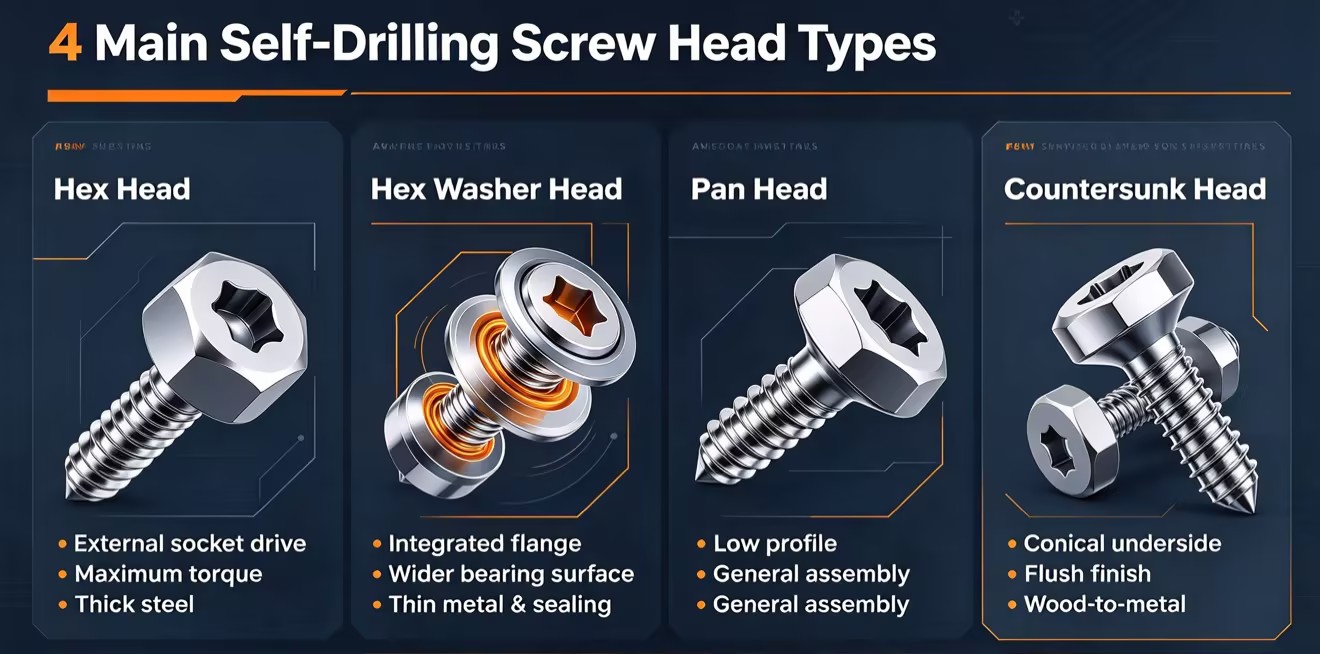
Hex heads have a six-sided external profile and are tightened with socket tools or magnetic nut setters. Common drive sizes include 1/4-inch, 5/16-inch, and 3/8-inch, depending on the screw size.
The external socket grips the full head, allowing high torque with little risk of cam-out. This makes Hex heads suitable for thick steel, structural framing, HVAC work, and heavy machinery where strong clamping and fast installation are more important than a flush finish.
The head protrudes from the surface and can catch on wiring, equipment, or clothing. It can also create problems where space is limited or where the joint is exposed to strong side loads.
Hex Washer heads combine a hex drive with a built-in flange, removing the need for a separate washer. The wider base spreads the load over a larger area and helps prevent damage to thin sheet metal, plastics, and insulation.
They are widely used for metal roofing, wall panels, fiberglass, and wood-to-metal connections. The wider base also helps keep the screw stable during drilling, while an EPDM washer can be added for weather sealing.
Over-tightening can bend the built-in washer or damage the EPDM seal. Use a controlled driving force and stop when the seal is slightly compressed without tearing or excessive deformation.
Pan heads have a rounded top, flat underside, and internal drives such as Phillips, Square, or Torx. Their lower profile is less likely to snag than a Hex head while still providing good clamping force.
They work well for general metal-to-metal fastening, including electrical enclosures, machinery panels, lighting systems, and automotive parts. They are also useful when a cleaner appearance is needed without requiring a fully flush head.
The main risk is cam-out, especially with Phillips drives during high-speed drilling. If the bit slips, the drive can become damaged and difficult to remove, increasing installation time and material damage.
Countersunk heads have a flat top and angled underside, commonly 82° or 90°, allowing the screw to sit flush with or slightly below the surface. This is useful where smooth surfaces and clearances are important.
They are often used for wood-to-metal fastening, plywood on steel studs, cabinetry, and trailer decking. Some designs include cutting ribs that help the head sink into wood without excessive splitting.
The surface must be thick enough to hold the angled head. In thin sheet metal, the countersunk shape can enlarge the hole and weaken the joint. These heads also have lower torque capacity than Hex or Hex Washer designs, making them less suitable for thick structural steel.
Choose the screw head based on material, load, finish, and installation conditions. Hex heads suit high-torque work, Hex Washer heads help spread loads on thin materials, Countersunk heads provide a flush finish, and Pan heads offer a general-purpose option.
Application Requirement | Preferred Head Type | Main Reason |
|---|---|---|
High Torque / Thick Steel | Hex > Hex Washer > Pan > Countersunk | External drives handle high torque and heavy installation loads. |
Thin Material / Pull-Through Resistance | Hex Washer > Pan > Hex > Countersunk | The wider bearing surface reduces the risk of pull-through. |
Flush Finish / Limited Clearance | Countersunk > Pan > Hex Washer > Hex | The angled underside allows the head to sit below the surface. |
Vibration Resistance | Hex Washer > Hex > Pan > Countersunk | Larger bearing surfaces help resist loosening under vibration. |
The drive recess affects torque, installation speed, and the risk of the bit slipping out. Phillips is simple but has a higher cam-out risk, Square (Robertson) provides better bit hold, Torx handles high torque with low cam-out, and External Hex provides the strongest drive for Hex and Hex Washer heads.
Drive Style | Common Head Type | Cam-Out Risk | Torque Capacity |
|---|---|---|---|
Phillips | Pan, Countersunk | High | Low |
Square (Robertson) | Pan, Countersunk | Low | High |
Torx | Pan, Countersunk | Very Low | Very High |
External Hex | Hex, Hex Washer | Very Low | Maximum |
For high-volume assembly, Hex and Hex Washer screws are often faster to install because magnetic nut setters can hold the fastener securely and support one-handed driving. Pan and Countersunk screws need more accurate bit alignment, which can increase bit wear, installation time, and damage to the workpiece.
Head selection may also depend on product standards and building requirements. Metal roofing applications may require heads with enough bearing area to resist pull-through under high loads, while fire-rated drywall systems may require specific countersunk profiles so the screw can be covered correctly without damaging the board surface.
A flush Countersunk head looks clean, but it may weaken thin sheet metal because its angled underside pushes the material outward. For thin metal enclosures, a Pan head can provide better joint strength, while thicker material may be needed when a Countersunk head is required.
Exposed Hex and Pan heads are easier to coat or protect against corrosion, while Countersunk heads can trap water around the drive recess and head edge. In outdoor or washdown environments, the head design and surface protection should be considered together.
The cheapest screw is not always the lowest-cost option. Pan heads may cost less, but frequent cam-out can increase labor, tool wear, and material damage. A slightly more expensive Hex Washer or similar drive may reduce total installation cost by improving speed and reducing failures.
Take the following actions to optimize your fastener specifications and eliminate joint failures on your next project:
Audit your current assembly lines for fastener failure rates, specifically tracking cam-outs, pull-throughs, and sheared heads to identify incorrect head profiles.
Measure the exact thickness of your top-layer substrates to verify they can safely accommodate countersunk profiles without wedging or tearing the material.
Upgrade internal drive specifications from Phillips to Torx or Square drives to immediately reduce installation fatigue, bit wear, and scrapped fasteners.
Implement torque-limiting drill-drivers across your production floor to prevent over-driving, thread stripping, and washer deformation in thin-gauge applications.
A: A pan head uses an internal drive recess like Phillips or Torx and features a low-profile domed top. It offers a cleaner look but carries a higher risk of cam-out. A hex head uses an external socket drive, providing a protruding, bulky profile that handles massive torque without slipping.
A: No. Thin sheet metal lacks the depth to accommodate the conical underside of a countersunk head. Driving them into thin gauges creates a wedge effect, enlarging the hole, distorting the metal, and severely weakening the joint's holding power.
A: The integrated flanged washer exponentially increases the bearing surface. This wide load distribution prevents the thin metal roofing panels from tearing or pulling over the screw head during severe wind-uplift events. It also provides a rigid backing for EPDM sealing washers.
A: Switch your fastener specification from Phillips drives to Torx (Star) or Square drives. These internal recesses feature straight vertical walls that transfer rotational force efficiently without requiring excessive downward pressure, nearly eliminating cam-out risks.
A: Yes. You measure countersunk (flat) heads from the very top of the head to the drill point. You measure non-countersunk heads (Hex, Pan, Washer) from the flat bearing surface underneath the head down to the drill point.
A: Over-torquing crushes the integrated metal flange and extrudes the EPDM rubber seal outward. This splits the rubber, destroys its elasticity, and creates a direct pathway for water to enter the joint, causing leaks and localized corrosion.