
 English


Views: 0 Author: Site Editor Publish Time: 2026-11-04 Origin: Site


Selecting the incorrect fastener head profile for metal-to-metal or metal-to-wood applications frequently results in stripped drives, compromised weather seals, or structural pull-through under dynamic loads. Engineers and contractors must balance installation speed, torque requirements, holding force, and aesthetic constraints. Misunderstanding the mechanical differences between hex washer heads and pan heads leads to inefficient assembly lines, increased material waste from cam-out, and potential joint failure.
While frequently confused with standard self-tapping screws (which often require pre-drilled holes and are limited to softer metals), self-drilling screws feature an integrated drill point, enabling single-operation fastening across a wider, tougher range of materials. This guide provides a technical evaluation of the hex head vs pan head self drilling screw, analyzing their torque capacities, load distribution mechanics, toughness, and optimal use cases to ensure specification accuracy.
Establishing the baseline geometric differences dictates how each screw interacts with driving tools and substrate materials. The physical shape of the fastener head governs rotational force transfer, downward pressure requirements, and ultimate joint stability. We must break down the specific anatomical features of both profiles to evaluate their mechanical advantages on the job site.
The hex washer head utilizes an external drive mechanism. Installers drive these screws using a magnetic nut setter or a dedicated hex socket. This external engagement surrounds the fastener head entirely, providing a massive surface area for the tool to grip. The design inherently resists slipping under heavy loads, allowing operators to drive fasteners rapidly without precision alignment.
Directly beneath the hexagonal top sits an integrated, unthreaded washer. This flat base plays a primary role in load management. You must distinguish between a true hex washer head and a hex flange screw. A hex washer head combines a standard hex profile with a flat washer base. A hex flange screw features a conical, sometimes serrated, integrated flange. Self-drilling variants predominantly utilize the flat hex washer head to prevent surface damage during high-RPM drilling operations.
The hex head features an uninterrupted structural core. Because it lacks an internal drive recess, the head maintains maximum solid mass. This solid construction delivers exceptional toughness under heavy rotational force. When penetrating thick structural steel, the solid head prevents shearing, ensuring the fastener remains intact even when the drill point encounters hard spots in the base metal.
Pan head screws rely on an internal drive mechanism. Manufacturers typically forge these heads with Phillips, Square (Robertson), or Torx (Star) recesses. The driving tool inserts directly into the center of the screw head. This internal engagement requires precise bit matching to function correctly. Using a worn bit or the wrong size immediately compromises the drive interface.
The physical profile features a slightly rounded top with a flat bearing surface underneath. This geometry creates a much lower overall height profile compared to bulky hex heads. The smooth, rounded top eliminates sharp edges, making it an excellent choice for applications requiring a clean finish or where personnel might brush against the assembled surface.
The internal drive design demands consistent downward pressure during installation. The operator must push hard against the screw to maintain bit engagement and prevent slipping. This end-load requirement directly impacts worker fatigue during high-volume assembly operations. If the operator relaxes their grip, the bit will jump out of the recess, damaging the fastener and potentially scratching the work surface.
Analyzing how head design impacts the transfer of rotational force from the tool to the fastener reveals distinct material suitabilities. Torque transfer efficiency dictates how quickly and safely a screw penetrates the substrate. Poor drive stability leads to damaged fasteners, ruined materials, and compromised structural joints.
Cam-out describes the tendency of a drive bit to slip out of the screw head recess as torque increases. This mechanical failure occurs when the rotational force exceeds the friction holding the bit inside the drive slot. Cam-out damages the screw head, shreds the driver bit, and often gouges the surrounding substrate material.
Pan head internal drives suffer heavily from cam-out risks. Phillips drives, in particular, were originally designed to cam-out to prevent over-tightening on early assembly lines. Today, this feature acts as a severe limitation. When drilling into tough metals, the bit frequently slips, stripping the recess and rendering the screw useless. Torx and Square drives mitigate this slightly by providing better engagement angles, but the risk remains high under heavy loads.
Hex head external drives virtually eliminate cam-out. The socket completely envelops the hexagonal head, providing positive, 360-degree engagement. This secure connection ensures consistent driving force. The tool cannot slip off the head, allowing the operator to apply maximum torque without fear of stripping the drive mechanism. This stability proves invaluable when working on ladders or in awkward positions where applying heavy end-load is impossible.
Self-drilling screws utilize different drill point sizes, commonly ranging from TEK 2 through TEK 5. The size of the drill point dictates the thickness of the metal it can penetrate. A TEK 2 point handles thin sheet metal, while a TEK 5 point can drill through half-inch structural steel.
| TEK Point Size | Max Material Thickness | Typical Application | Recommended Head Style |
|---|---|---|---|
| TEK 2 | Up to 0.110" | Light gauge sheet metal, HVAC | Pan Head or Hex Head |
| TEK 3 | Up to 0.210" | Medium steel framing, roofing | Hex Washer Head |
| TEK 4 | Up to 0.312" | Heavy steel framing, structural | Hex Washer Head |
| TEK 5 | Up to 0.500" | Thick structural steel, I-beams | Hex Washer Head |
Thicker steel substrates require massively higher torque to penetrate and thread. The fastener must endure extreme friction and rotational stress. Hex heads safely absorb this force without head shearing or drive stripping. The solid mass of the hex head handles the high torque output of modern 18V impact drivers, resulting in a higher ultimate holding force and a secure joint.
Pan heads generally restrict you to lighter-gauge metals or softer materials. The internal recess weakens the overall head structure. Applying TEK 5 level torque to a standard pan head often results in the head snapping off or the drive recess stripping completely. Therefore, pan heads suit applications where lower torque remains sufficient for penetration.
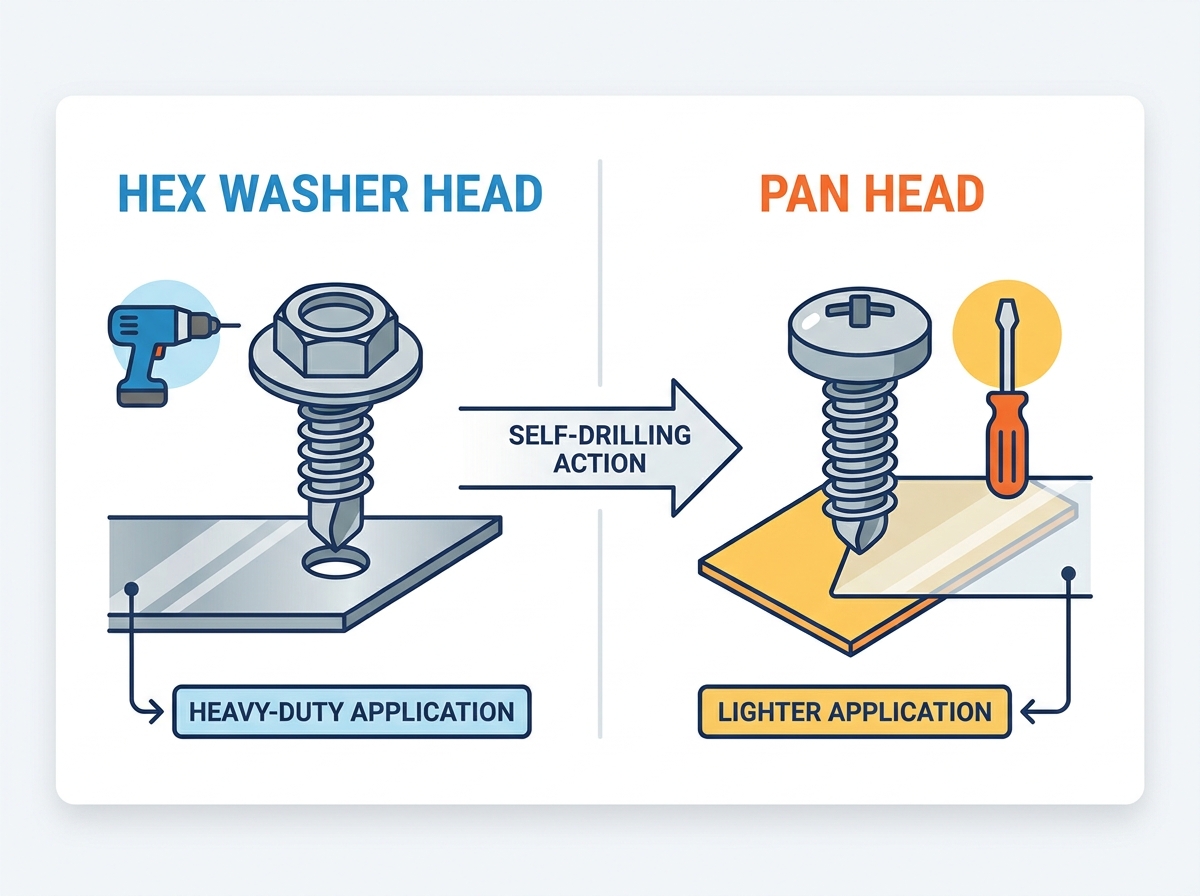
Assessing how the bearing surface of the screw head affects the clamped materials helps you optimize assembly efficiency. The underside of the fastener head must distribute the clamping load effectively to prevent material failure. Different head profiles offer vastly different bearing footprints, directly influencing the mechanical strength of the completed assembly.
The integrated washer of the hex head spans a significantly wider diameter than the core thread size. This wide base distributes the clamping load over a large surface area. By spreading the pressure, the hex washer head reduces localized stress on the top layer of the material.
This load distribution proves necessary when fastening thin sheet metal, softer metals like aluminum, or brittle composite materials. High localized stress easily causes thin metals to tear. The wide bearing surface provides exceptional pull-through resistance, ensuring the screw head does not crush or punch through the top substrate under heavy wind loads or structural shifting. For example, securing 26-gauge metal roofing panels requires the wide footprint of a hex washer head to withstand severe wind uplift forces.
Pan heads feature a much smaller bearing footprint. The clamping force concentrates into a tight circle immediately surrounding the screw shaft. This concentrated pressure works perfectly for rigid, thicker top-layer materials that resist crushing. However, using pan heads on thin-gauge sheet metal introduces a high risk of pull-through failure. If the joint experiences tension, the small pan head will simply rip through the thin metal.
| Feature | Hex Washer Head | Pan Head |
|---|---|---|
| Drive Type | External (Socket/Nut Setter) | Internal (Phillips/Square/Torx) |
| Cam-Out Risk | Extremely Low | High (especially with Phillips) |
| Bearing Surface Area | Large (Integrated Washer) | Small (Concentrated) |
| Pull-Through Resistance | Excellent | Moderate to Low |
| Optimal Substrate | Thick Steel, Thin Sheet Metal | Light Gauge Metal, Rigid Plastics |
Industrial environments subject fasteners to constant dynamic loads. The wider bearing surface of hex washer heads provides superior resistance to loosening in high-vibration environments. Applications like HVAC ductwork, industrial machinery housing, and metal roofing rely on this wide footprint to maintain joint tension over decades of vibration.
The hex head design significantly boosts assembly speed on production lines. Because the socket grips the head securely, operators spend less time aligning bits and applying downward pressure. The larger grip surface stabilizes the fastener during the initial drilling phase. This stability allows workers to drive screws faster and with greater confidence compared to precision-dependent pan heads.
Matching the fastener to the physical and environmental constraints of the project ensures long-term durability. You must evaluate weather exposure, visual requirements, and spatial limitations before specifying a head profile. Fasteners perform vastly different roles depending on their operating environment.
Hex heads serve as the undisputed industry standard for metal roofing and exterior cladding. Exterior applications demand absolute waterproofing to protect the building envelope. Contractors achieve this by pairing self-drilling screws with EPDM (Ethylene Propylene Diene Monomer) rubber sealing washers.
The flat, wide flange of the hex washer head perfectly compresses the EPDM washer against the metal panel. As torque increases, the flat base pushes the rubber outward uniformly, creating a watertight, 360-degree seal around the drill hole. The rigid washer backing prevents the rubber from extruding upward or tearing. Installers look for a slight "squish" of the rubber visible just beyond the metal washer edge to confirm a proper seal.
Pan heads cannot uniformly compress sealing washers. Their smaller bearing surface tends to dig into the rubber, causing uneven compression and eventual seal failure. The rounded underside of some pan heads will actually cut the rubber under high torque. Consequently, engineers generally deem pan heads unsuitable for primary weatherproofing applications where moisture intrusion poses a structural risk.
Many assemblies impose strict spatial limitations. Pan heads are specified when the fastener must not protrude significantly above the material surface. You will frequently find them inside sliding door tracks, under moving mechanical components, or securing consumer-facing appliance panels.
The low-profile, rounded top of the pan head allows moving parts to glide over the fastener without interference. If you install a hex head inside a window frame track, the sliding sash will hit the bulky fastener head and jam. The pan head provides a cleaner, more finished look for visible joints. When aesthetics and tight tolerances dictate the design, the pan head excels.
Conversely, hex heads pose a snag hazard. The bulky, protruding profile easily catches on clothing, wiring, or moving machinery. In highly visible areas or tight-tolerance assemblies, the industrial look and physical bulk of a hex head become a distinct liability. You must map out the mechanical clearances of your assembly before choosing the fastener profile.
Understanding common failures during installation helps you implement preventative measures. Even the highest-quality fasteners fail if installed incorrectly. You must train operators to recognize the specific risks associated with different head profiles and drill points.
Because hex heads do not cam-out, operators face a different mechanical risk: over-torquing. Modern impact drivers deliver immense rotational force. Once the self-drilling screw penetrates the metal and the threads engage, the operator must stop driving immediately. If they continue applying power, the screw will act like a drill bit and strip the newly formed threads out of the base material.
This stripping risk increases dramatically in softer metals like aluminum or thin-gauge steel. To mitigate this, mandate the use of torque-limiting clutches on all installation drills. Alternatively, equip tools with depth-sensing nosepieces that automatically disengage the drive mechanism once the screw head sits flush against the substrate. This removes the human error element from the final seating phase.
A common field error involves selecting a self-drilling screw based entirely on the head type while ignoring the drill point length. The unthreaded drill flute must be longer than the total combined thickness of the materials being drilled. If the threads engage the top material before the drill point finishes cutting through the bottom material, the screw binds. The threads try to pull the screw forward faster than the tip can drill, causing the head to snap off.
Mitigate this risk by standardizing TEK point selection charts across your engineering and procurement teams. Ensure operators understand that a TEK 3 point handles up to 0.210" steel, while a TEK 5 point handles up to 0.500" steel. Match the flute length to the material stack-up perfectly before beginning installation.
Internal drives require significant operator fatigue. Pushing force, or end-load, keeps the Phillips or Torx bit seated inside the pan head recess. Over a long shift, this constant pushing exhausts operators, slowing down installation speeds and increasing the likelihood of sloppy, off-angle driving. Fatigue leads directly to increased cam-out rates and damaged materials.
For high-volume assembly environments without strict clearance issues, default to hex washer heads. Pairing hex heads with magnetic nut setters eliminates the need for heavy end-load. The tool holds the screw securely, allowing the operator to let the drill do the work. This simple switch increases throughput and dramatically reduces operator strain and repetitive motion injuries.
Measure the total combined thickness of your substrate materials to determine the correct TEK drill point size and flute length.
Select the appropriate corrosion-resistant coating based on the specific environmental exposure of the installation site.
Equip installation crews with torque-limiting drivers to prevent thread stripping in lighter-gauge substrates.
Standardize magnetic nut setters for all hex head applications to reduce operator fatigue and increase daily throughput.
A: The hex washer head handles significantly higher installation torque. Its external drive design allows a socket to grip the outside of the head, providing 360-degree engagement. This prevents the tool from slipping and allows the solid metal head to absorb heavy rotational force without shearing.
A: A hex washer head features a standard hexagonal top with a distinct, flat washer base integrated underneath. A hex flange screw features a conical base that tapers out from the hex head, which is often serrated. Self-drilling screws usually use the flat washer design to avoid scratching the surface.
A: No. Metal roofing requires EPDM rubber sealing washers to prevent leaks. The small bearing surface of a pan head cannot compress the rubber washer evenly. This leads to uneven seals, rubber extrusion, and eventual water intrusion. Always use hex washer heads for exterior weatherproofing.
A: The built-in flat washer flange increases the bearing surface area of the screw. This wide footprint distributes the clamping load over a larger area. It prevents the screw head from crushing soft materials or pulling through thin sheet metal under heavy stress or vibration.
A: Use the exact size and style of driver bit specified for the screw recess. Apply firm, consistent downward pressure perfectly in line with the screw shaft. Avoid using excessive RPMs on your drill. Switching to Torx or Square drives also significantly reduces cam-out compared to Phillips drives.
A: Self-tapping screws feature a sharp, pointed tip designed to cut threads into pre-drilled holes or very soft materials. Self-drilling screws feature an integrated drill bit tip (TEK point) that allows them to drill their own hole and cut threads in a single operation, even in thick steel.
A: No. Self-drilling screws are specifically engineered to eliminate the need for pre-drilling. Their integrated drill point cuts through the material, and the trailing threads secure the joint. Pre-drilling defeats the purpose of the fastener and can actually compromise the thread engagement.