
 English


Views: 0 Author: Site Editor Publish Time: 2026-09-28 Origin: Site


Fastener failure in structural and mechanical joints rarely happens because of a material defect. It usually results from specifying the wrong fastener geometry for the applied load. Engineers and procurement teams frequently face the choice between partial-thread and full-thread Hex Bolts. Selecting the wrong specification leads to shear failure, excessive joint settlement, or unnecessary inventory bloat. This guide provides a direct technical comparison of DIN 931 vs DIN 933 hex bolts. We evaluate their structural mechanics, load capacities, and procurement trade-offs to ensure accurate specification for heavy machinery and structural applications.
Defining the physical parameters and visual identifiers that separate these two dominant hex bolt standards establishes baseline success criteria for joint design. Fastener geometry directly dictates how forces transfer through a mechanical connection. Recognizing the structural anatomy of each bolt type prevents specification errors during the engineering phase.
The DIN 931 standard defines a hexagon head bolt featuring a partial metric exterior male thread. The defining characteristic is its unthreaded shank, also known as the grip length. This smooth cylindrical section sits between the bolt head and the threaded portion. Shop floor technicians and mechanics frequently refer to these as half-thread bolts.
The length of the threaded portion follows strict mathematical formulas based on the nominal length and diameter of the bolt. It is never arbitrary. For bolts with a total length up to 125 mm, the thread length is calculated as twice the nominal diameter plus 6 mm. For lengths between 125 mm and 200 mm, the formula shifts to twice the diameter plus 12 mm. Bolts exceeding 200 mm in length utilize a formula of twice the diameter plus 25 mm. This standardized calculation ensures predictable grip lengths for engineering calculations.
Consider an M16 x 100 mm DIN 931 bolt. Using the formula for bolts under 125 mm, the thread length is (16 x 2) + 6, which equals 38 mm. The remaining 62 mm forms the solid unthreaded shank. If you specify an M16 x 150 mm bolt, the formula changes. The thread length becomes (16 x 2) + 12, equaling 44 mm. The solid shank is now 106 mm. Mechanics rely on these exact dimensions to position the shear plane correctly.
Global manufacturing is currently transitioning from the DIN 931 standard to its international equivalent, ISO 4014. This shift introduces minor dimensional changes that engineers must account for. Specifically, the across-flats dimensions (wrench sizes) change for several common diameters.
| Thread Diameter | DIN 931 Wrench Size (mm) | ISO 4014 Wrench Size (mm) |
|---|---|---|
| M10 | 17 | 16 |
| M12 | 19 | 18 |
| M14 | 22 | 21 |
| M22 | 32 | 34 |
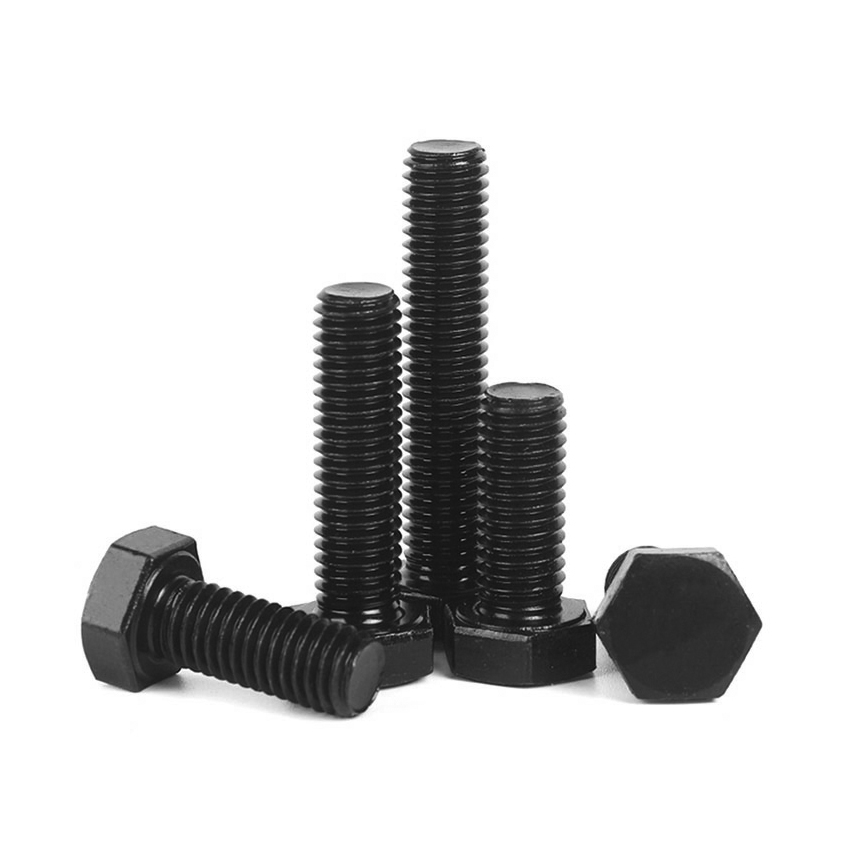
The DIN 933 standard specifies a hexagon head bolt with threads running continuously from the tip to the underside of the head. A minimal unthreaded run-out exists at the under-head radius to prevent stress fractures at the junction. The functional thread covers the entire shaft.
This full-thread geometry offers a distinct manufacturing advantage for variable clamping lengths. A single bolt length secures materials of vastly different thicknesses. They are also mandatory for blind tapped holes where the bolt must thread directly into a machined component without bottoming out on an unthreaded shank.
Similar to its partial-thread counterpart, DIN 933 is being replaced by ISO 4017. The transition to ISO 4017 carries the exact same wrench size adjustments noted for ISO 4014. Updating engineering drawings to reflect ISO 4017 ensures proper tool selection during assembly and maintenance operations. Using the wrong socket size strips the bolt head and halts assembly lines.
Standard metric coarse threads do not fit every application. High-vibration environments or assemblies requiring ultra-precise tension adjustments demand finer thread pitches. A finer pitch provides a larger minor diameter. This increases the tensile stress area of the fastener. It also creates a shallower helix angle, which significantly improves resistance to vibration-induced loosening.
The fine-thread equivalents map directly to the coarse-thread standards. DIN 960 serves as the fine-thread equivalent to the partial-thread DIN 931. DIN 961 functions as the fine-thread equivalent to the full-thread DIN 933. Specifying these fine-thread variants requires careful attention to mating nuts and tapped holes. Mixing coarse and fine pitches destroys the fastener threads immediately upon installation.
Fastener selection relies entirely on understanding how external loads interact with the bolt geometry. Joints experience different types of forces. The physical shape of the bolt determines its survival under stress.
Shear force occurs when forces push perpendicular to the bolt axis. Imagine two overlapping steel plates pulled in opposite directions. The bolt connecting them acts as a pin resisting that sliding motion.
The solid shank of a DIN 931 bolt provides maximum shear strength. It acts as the primary load-bearing surface. The smooth, continuous cylinder of steel offers the maximum possible cross-sectional area to resist the slicing action of the plates.
Using a DIN 933 bolt in a shear application introduces severe mechanical vulnerabilities. The valleys of the threads act as stress risers. When placed in a shear plane, these sharp internal corners concentrate mechanical stress. The cross-sectional area at the thread root is significantly smaller than the nominal diameter of the bolt. This combination of reduced material area and concentrated stress leads to premature shear fracture under heavy loads.
To identify shear-loaded joints in the field, look for these characteristics:
Tensile force occurs when forces pull parallel to the bolt axis, attempting to stretch the fastener. In a tension-dominated joint, the plates try to separate, pulling against the bolt head and the nut.
When evaluating pure tensile performance, both standards perform similarly. Tensile failure almost always occurs in the threaded section of a bolt because it represents the smallest cross-sectional area. Assuming identical material grades, nominal diameters, and thread pitches, a DIN 931 bolt and a DIN 933 bolt possess the exact same tensile load capacity. The presence of an unthreaded shank above the threads does not increase the ultimate tensile strength of the fastener.
Mechanical assemblies often rely on bolts to align mating components. The smooth shank of a DIN 931 bolt acts as an effective dowel pin. It fits snugly into a properly toleranced clearance hole. This restricts lateral movement and ensures precise alignment of heavy machine parts.
Using a fully threaded DIN 933 bolt for alignment introduces significant joint settlement risks. Threads have inherent clearance to allow for nut installation. This clearance translates to lateral slop within the bolt hole. The sharp crests of the threads bear directly against the smooth inside wall of the clearance hole. Under heavy vibration or shifting loads, these thread crests embed into softer mating materials. This microscopic yielding causes the joint to relax. As the joint settles, the bolt loses its preload, leading to rapid, vibration-induced loosening.
Matching the fastener to the specific mechanical environment guarantees long-term joint integrity. Engineering context dictates whether a partial thread or full thread provides the optimal solution.
Engineers specify partial-thread bolts for heavy-duty structural applications. Typical use cases include heavy machinery assembly, structural steel connections, and automotive suspension systems.
These bolts excel in applications where the fastener must act as a pivot pin. The smooth shank provides a wear-resistant surface for rotating components. They are mandatory for joints absorbing high lateral or transverse loads.
Successful implementation requires precise grip length calculations. The design must ensure the unthreaded shank spans the entire shear zone. The threads must begin only after exiting the shear plane. This allows the nut to engage without compromising the shear capacity of the joint.
Full-thread bolts dominate applications lacking a traditional through-hole and nut configuration. They are the primary choice for tapped hole applications where the bolt threads directly into a machined casting or component housing.
Sheet metal assemblies and thin-material joints rely heavily on DIN 933 bolts. If a partial-thread bolt is used on very thin materials, the nut bottoms out on the thread run-out before achieving proper clamping force against the material surface. Full threads ensure the nut can travel all the way to the underside of the bolt head.
They provide utility in situations requiring high adjustability. When the exact grip length fluctuates due to manufacturing tolerances or varying component thicknesses, a full-thread bolt guarantees sufficient thread engagement regardless of the final clamping dimension.
Geometry alone does not define a fastener's capability. The underlying material science and surface treatments heavily influence the performance of both partial and full-thread bolts.
Metric hex bolts are classified by property classes rather than standard grades. The most common property classes available for both standards are 8.8, 10.9, and 12.9.
An 8.8 class bolt represents medium carbon steel that has been quenched and tempered. Class 10.9 utilizes alloy steel for higher strength applications. Class 12.9 represents the highest standard strength, used in heavy equipment assemblies.
| Property Class | Material Type | Minimum Tensile Strength (MPa) | Minimum Yield Strength (MPa) |
|---|---|---|---|
| 8.8 | Medium Carbon Steel (Q&T) | 800 | 640 |
| 10.9 | Alloy Steel (Q&T) | 1000 | 900 |
| 12.9 | Alloy Steel (Q&T) | 1200 | 1080 |
Stainless steel variants follow a different classification system. A2-70 (similar to 304 stainless) and A4-80 (similar to 316 marine-grade stainless) are the industry standards. Material selection interacts directly with thread geometry. A lower-strength material combined with the stress risers of a full-thread DIN 933 bolt in a shear application creates a highly vulnerable joint.
Industrial environments require protective coatings to prevent rapid oxidation. Common surface treatments include zinc plating, hot-dip galvanizing, and PTFE coatings.
These coatings add physical thickness to the fastener. Standard metric threads utilize a 6g tolerance class. Thick coatings like hot-dip galvanizing add up to 50 microns of material. This pushes the threads out of tolerance and prevents nut installation. Manufacturers often tap the mating nuts oversize to accommodate galvanized bolts.
Thread galling presents a specific challenge for stainless steel fasteners. Galling is a form of cold welding. Friction destroys the protective oxide layer on the stainless steel, causing the threads to fuse together during installation. Full-thread DIN 933 bolts have significantly more threaded surface area engaging with the nut or tapped hole. This increased friction area makes them more susceptible to thread galling than DIN 931 bolts.
To mitigate galling during installation, mechanics should follow these steps:
Balancing engineering requirements with supply chain efficiency requires a clear understanding of manufacturing realities and inventory management risks.
A common misconception exists regarding the manufacturing complexity of these two bolt types. DIN 933 bolts are slightly easier to produce in mass quantities. The thread rolling machine processes a single, uniform blank diameter in one continuous pass. Producing a DIN 931 bolt requires an additional extrusion step to create the reduced pitch diameter section before thread rolling.
Despite this minor manufacturing difference, specification must be driven entirely by engineering requirements. Attempting to simplify procurement by purchasing the wrong bolt type ignores the consequences of joint failure. The operational impact of a sheared bolt shutting down a production line or causing structural collapse far exceeds any perceived convenience on the initial fastener order.
Procurement departments frequently attempt to streamline operations by standardizing their fastener inventory. A common strategy involves stocking only fully threaded DIN 933 bolts. The logic appears sound on the surface: a full-thread bolt accommodates any material thickness, effectively covering all length requirements and drastically reducing SKU counts in the warehouse.
Engineering teams must strongly push back against this practice. Standardizing exclusively on DIN 933 across a facility compromises safety in shear-loaded applications. While it simplifies purchasing, it forces maintenance teams to install fully threaded bolts into shear planes. This inventory strategy directly introduces stress risers into machinery, elevating the risk of sudden mechanical failure. Facilities must maintain distinct inventories for shear applications (DIN 931) and tension/tapped applications (DIN 933).
Even with correct inventory available, installation errors compromise joint integrity. Field technicians must understand how to verify correct fastener application during assembly.
The most severe risk involves placing threads directly across the joint interface. This occurs when a technician uses a DIN 933 bolt in a shear joint, or when they select a DIN 931 bolt with an unthreaded shank that is too short for the application.
When the plates shift, the sharp thread valleys concentrate the shear force. This initiates microscopic cracks that rapidly propagate through the bolt cross-section.
Mitigation requires strict engineering reviews of grip length calculations before assembly. If a standard DIN 931 bolt length does not perfectly align the unthreaded shank with the shear plane, technicians utilize hardened flat washers under the bolt head or nut. Adding washers effectively shifts the bolt backward or forward within the hole. This allows precise positioning of the solid shank directly across the shear interface.
Specifying a DIN 931 bolt carries the opposite risk: selecting a bolt where the unthreaded shank is too long for the clamped material thickness.
In this scenario, the nut threads onto the bolt and eventually hits the thread run-out. The wrench registers high torque, and a torque wrench clicks, indicating a tight joint. However, the nut is merely jammed against the bolt shaft, not pressing against the clamped material. The joint remains completely loose, susceptible to immediate vibration failure.
Mitigation requires precise measurement of the total joint thickness, including all washers and gaskets. Engineers utilize standardized grip length charts to select a bolt where the unthreaded shank is slightly shorter than the total clamped thickness. This ensures the nut applies full clamping force directly to the material surface.
Applying torque to a fastener generates the clamping force required to hold the joint together. The geometry of the bolt influences how much of that applied torque converts into actual preload.
When torquing a DIN 931 bolt, the smooth shank provides a consistent stretch profile. The unthreaded section elongates predictably under tension. This predictable elongation allows mechanics to achieve highly accurate preload values using standard torque wrenches or turn-of-nut methods.
Conversely, a fully threaded DIN 933 bolt introduces more variables into the torque-tension relationship. The continuous threads create a non-uniform cross-section along the entire length of the bolt. As torque is applied, the threads deform slightly, absorbing some of the rotational energy. This deformation increases the scatter in preload values. Mechanics must account for this variability when specifying torque values for critical DIN 933 installations, often requiring more frequent retorquing intervals during initial equipment break-in periods.
Washers do more than just protect the surface of the clamped material. They actively manage the geometry of the bolted joint.
When using DIN 931 bolts, mechanics use hardened flat washers to adjust the position of the thread run-out. If the unthreaded shank is slightly too long, adding a washer under the nut shifts the engagement point outward. This prevents the nut from bottoming out on the run-out and ensures full clamping force transfers to the joint.
For DIN 933 bolts, washers distribute the clamping load over a larger surface area. Because the threads extend all the way to the head, the under-head radius is minimal. A hardened washer provides a smooth, consistent bearing surface for the bolt head to rotate against during installation. This reduces friction and prevents the bolt head from galling into the softer base material.
| Feature | DIN 931 (ISO 4014) | DIN 933 (ISO 4017) |
|---|---|---|
| Thread Coverage | Partial Thread (Solid Shank) | Full Thread (To the Head) |
| Primary Load Suitability | High Shear & Tension | Tension & Tapped Holes |
| Alignment Capability | Excellent (Acts as dowel pin) | Poor (Threads allow slop) |
| Joint Settlement Risk | Low | High (Thread crest embedding) |
| Ideal Material Thickness | Thick / Structural | Thin / Variable / Blind Holes |
To ensure joint integrity and operational safety, implement the following actions:
A: You should not substitute a DIN 933 bolt for a DIN 931 bolt in shear-loaded applications. The threads on a DIN 933 bolt create stress risers and reduce the cross-sectional area. Placing these threads in the shear plane significantly lowers the load capacity and increases the risk of premature fracture.
A: The international equivalent for DIN 931 is ISO 4014. The transition to the ISO standard includes minor dimensional changes, most notably adjusting the across-flats wrench size dimensions for M10, M12, M14, and M22 diameters.
A: Thread length is standardized based on bolt dimensions. For bolts up to 125 mm long, thread length equals twice the diameter plus 6 mm. For lengths between 125 mm and 200 mm, it is twice the diameter plus 12 mm. For bolts over 200 mm, it is twice the diameter plus 25 mm.
A: In pure tension, both bolts offer identical strength if they share the same material grade and diameter, as failure occurs in the threaded section. However, in shear applications, DIN 931 bolts are significantly stronger because the solid unthreaded shank absorbs the lateral forces.
A: When used in a clearance hole, the sharp crests of a fully threaded bolt bear directly against the smooth inside wall. Under vibration or heavy loads, these threads embed into the softer mating material. This microscopic yielding relaxes the joint, causing a loss of clamping force.
A: Property class 8.8 indicates a medium carbon steel bolt that has been quenched and tempered. The first number represents a nominal tensile strength of 800 MPa. The second number indicates that the yield strength is 80% of the tensile strength, equating to 640 MPa.