
 English


Views: 0 Author: Site Editor Publish Time: 2026-11-04 Origin: Site


Upgrading fasteners is often viewed as a quick, low-cost method to increase the reliability and load capacity of mechanical assemblies. Mechanics and fabricators frequently assume a higher number on the bolt head guarantees a stronger, safer joint. However, deciding to replace 8.8 bolt with 10.9 hardware is not a simple one-to-one swap. While class 10.9 offers higher tensile strength, introducing a harder fastener alters the joint's torque requirements, clamping force, and failure modes, potentially causing thread stripping or catastrophic brittle failure. To determine if a 10.9 upgrade is a safe and effective solution, engineers and technicians must evaluate the base materials, mating hardware, and specific load types (tension versus shear) of the application.
Metric fastener classes follow a specific naming convention defined by international standards. The two numbers separated by a decimal point provide a direct reference to the fastener's mechanical properties. The first number represents the ultimate tensile strength in hundreds of megapascals (MPa). The second number represents the ratio of yield strength to tensile strength as a percentage. You need to understand these metallurgical differences before swapping hardware on the shop floor.
The performance gap between these two fastener classes stems directly from their chemical composition and thermal processing. Class 8.8 bolts typically consist of medium carbon steel. Manufacturers quench and temper this steel to achieve a balance of strength and ductility suitable for general engineering applications. The tempering process relieves internal stresses. This allows the bolt to stretch slightly under extreme loads before failing.
Class 10.9 bolts utilize low-to-medium carbon alloy steel. The addition of alloying elements like chromium, molybdenum, or nickel increases the material's hardenability. After quenching and tempering, the alloy steel achieves a much higher surface and core hardness. This advanced heat treatment produces a fastener capable of sustaining massive clamping forces. The increased hardness inherently reduces the material's ability to deform plastically.
Evaluating joint integrity requires a clear understanding of yield and tensile limits. Yield strength marks the point of permanent deformation. If a load stretches a bolt past its yield point, the fastener will not return to its original length once you remove the load. Tensile strength marks the ultimate point of failure, where the fastener physically snaps or pulls apart.
Class 8.8 fasteners offer a nominal tensile strength of approximately 800 MPa and a nominal yield strength of 640 MPa (80% of the tensile strength). These bolts handle moderate loads effectively and provide a wide margin of plastic deformation. If an assembly experiences unexpected overload, an 8.8 bolt will stretch noticeably before breaking. This stretching provides a visual warning of impending failure during routine inspections.
Class 10.9 fasteners step up the performance with a nominal tensile strength of roughly 1040 MPa and a yield strength of 900 MPa to 940 MPa (approximately 90% of the tensile strength). This represents a massive increase in load-carrying capacity. The margin between yield and ultimate failure is much narrower. Once a 10.9 bolt exceeds its yield point, it requires very little additional force to snap completely.
| Property | Class 8.8 | Class 10.9 |
|---|---|---|
| Material | Medium Carbon Steel | Alloy Steel |
| Heat Treatment | Quenched and Tempered | Quenched and Tempered |
| Nominal Tensile Strength | 800 MPa | 1040 MPa |
| Nominal Yield Strength | 640 MPa | 940 MPa |
| Core Hardness (Rockwell) | HRC 22 - 32 | HRC 32 - 39 |
| Ductility | High (Bends before breaking) | Low (Prone to snapping) |
Upgrading fastener grades makes sense only when the specific mechanical demands of the joint align with the properties of the harder bolt. You must analyze the primary forces acting on the assembly. Successful upgrades typically occur in environments dominated by high static tension rather than dynamic shear.
The most justifiable scenario for a 10.9 upgrade involves joints where the primary failure mode of the existing 8.8 bolt was stretching under static axial loads. Axial loads pull straight down the shaft of the bolt. If an assembly separates under pressure—such as a hydraulic cylinder head or a high-pressure pipe flange—the existing fasteners lack the necessary clamping force. Upgrading to 10.9 allows you to apply higher torque. This generates a stronger clamping force that keeps the joint faces tightly compressed.
Gasket blowouts frequently indicate insufficient clamping force. When internal pressure exceeds the compressive force holding the flanges together, the gasket fails. By installing 10.9 bolts and applying the appropriate higher torque, you increase the preload on the joint. This ensures the flanges remain sealed even during pressure spikes, preventing leaks and equipment downtime.
Engineers often utilize class 10.9 hardware to optimize assembly design through downsizing. Because a 10.9 bolt carries roughly 30% more load than an identically sized 8.8 bolt, you can substitute a smaller diameter fastener while maintaining the same overall joint strength. Replacing an M12 class 8.8 bolt with an M10 class 10.9 bolt yields a similar clamping capacity.
This downsizing strategy provides significant advantages in complex assemblies. Smaller bolts require smaller nuts, smaller washers, and less clearance space for tooling. This reduces the overall footprint of the joint flange. In automotive, aerospace, and mobile equipment manufacturing, this translates directly to weight reduction. Shedding ounces across hundreds of connection points improves fuel efficiency and payload capacity.
Here are the standard steps for executing a fastener downsizing strategy:
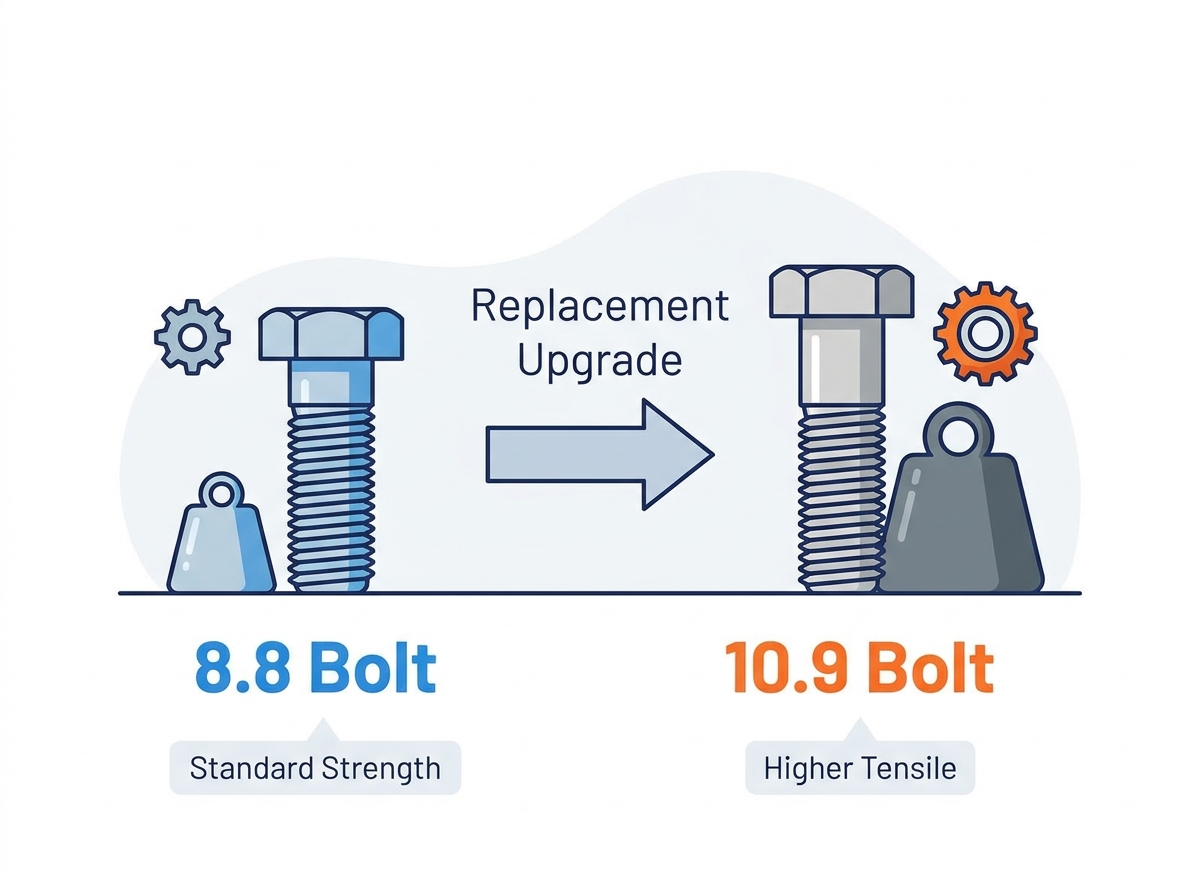
Dropping a stronger bolt into an existing hole rarely solves mechanical problems without introducing new variables. The surrounding components must endure the increased forces generated by the upgraded hardware. Failing to account for these implementation realities often results in damaged equipment and compromised safety.
Bolts function as highly rigid springs. To hold a joint tightly, the bolt must be stretched by applying rotational torque to the nut or bolt head. This stretching creates tension in the bolt, which pulls the clamped materials together. This resulting compression is known as preload. Every bolt class requires a specific amount of stretch to achieve its optimal preload, usually calculated at 75% to 80% of its yield strength.
If you install a 10.9 bolt but only tighten it to the torque specifications of the original 8.8 bolt, you create a dangerous under-torque scenario. The harder 10.9 bolt will not stretch sufficiently at the lower torque setting. Without adequate stretch, the bolt lacks the necessary spring tension to maintain friction on the threads. Vibrations and thermal cycling will quickly cause the under-torqued fastener to loosen, leading to joint failure.
Conversely, if you correctly tighten the 10.9 bolt to its higher required torque spec, you risk over-torquing the surrounding joint. The increased clamping force may exceed the compressive strength of the clamped components. If you are bolting together aluminum housings, plastic flanges, or thin sheet steel, the massive preload of a 10.9 bolt will crush or distort the base material long before the bolt reaches its optimal stretch.
| Bolt Size (Coarse Thread) | Class 8.8 Standard Torque (Nm) | Class 10.9 Standard Torque (Nm) | Percentage Increase |
|---|---|---|---|
| M8 x 1.25 | ~25 Nm | ~35 Nm | +40% |
| M10 x 1.5 | ~50 Nm | ~70 Nm | +40% |
| M12 x 1.75 | ~85 Nm | ~120 Nm | +41% |
| M14 x 2.0 | ~135 Nm | ~190 Nm | +40% |
The risk of material failure extends to internal threads. When threading a bolt into a tapped hole rather than using a through-hole and nut, the strength of the base metal dictates the maximum allowable torque. Cast iron, magnesium, and aluminum engine blocks possess significantly lower shear strength than alloy steel fasteners.
If you attempt to torque a 10.9 bolt to its proper specification inside a tapped aluminum hole, the internal threads will shear off and pull out. The harder bolt acts like a machining tool, stripping the softer metal before it can generate the required preload. In these scenarios, upgrading the bolt actually destroys the component. You must either stick to the original 8.8 specification or install steel thread inserts to distribute the load across a larger area of the soft base metal.
Joints subjected to forces perpendicular to the bolt shaft experience shear stress. In these applications, the ductility of the fastener becomes more critical than its ultimate tensile strength. An 8.8 bolt possesses high ductility. When subjected to extreme shear forces or sudden impacts, it will bend and deform plastically. This bending absorbs energy and keeps the joint loosely connected, providing operators with a visual warning that the hardware needs replacement.
A 10.9 bolt behaves differently under shear loading due to its higher hardness and lower ductility. It cannot absorb impact energy through plastic deformation. Instead, it resists the force rigidly until it reaches its breaking point, at which time it snaps suddenly and catastrophically. In applications like off-road vehicle suspensions or heavy equipment linkages, a snapping bolt causes immediate loss of control, whereas a bending bolt allows the machine to limp to safety.
Corrosion resistance often requires zinc electroplating. The electroplating process introduces atomic hydrogen into the steel matrix. High-strength steels, specifically those with a hardness above HRC 32 (which includes class 10.9 and above), are highly susceptible to hydrogen embrittlement. The trapped hydrogen atoms migrate to areas of high stress within the bolt, creating microscopic cracks that propagate under load.
This embrittlement causes delayed, unpredictable failure hours or days after installation, even under static loads well below the bolt's yield strength. To mitigate this risk, plated 10.9 fasteners must undergo a rigorous baking process immediately after electroplating to outgas the hydrogen. If you source cheap or counterfeit 10.9 hardware that skipped this baking process, you introduce a massive hidden risk into your assembly.
A bolted joint operates as a system. The bolt, nut, and washers must work in unison to distribute loads and maintain tension. Upgrading one component while neglecting the others creates severe weak points that compromise the entire assembly.
For high-load applications, the answer is a definitive "No." The nut must always match or exceed the property class of the bolt. Metric nuts follow a single-digit classification system that corresponds to the bolt class they are designed to fit. A class 10 nut pairs with a class 10.9 bolt, and a class 8 nut pairs with a class 8.8 bolt.
If you thread a class 8 nut onto a 10.9 bolt and apply the higher torque required to stretch the bolt, the threads inside the softer nut will strip. The nut will fail before the bolt achieves proper preload. Always procure matching class 10 nuts when performing an upgrade.
Technicians must avoid the dangerous confusion between SAE grades and metric classes. SAE Grade 8 is a high-strength imperial fastener roughly equivalent to metric 10.9. Metric Class 8.8 is a medium-strength fastener. Mixing these standards due to naming similarities leads to catastrophic thread mismatch and joint failure.
Standard flat washers cannot withstand the compressive forces generated by class 10.9 hardware. When you apply high torque, a standard washer will dish, deform, or extrude outward. This deformation causes an immediate loss of preload, allowing the joint to loosen.
The hardened underside of a 10.9 bolt head will gall and dig into a soft washer during tightening, creating inaccurate torque readings. You must install hardened, through-hardened steel washers designed specifically for high-tensile applications. These washers distribute the immense clamping load over a wider area, preventing the bolt head or nut from sinking into the base material and ensuring accurate torque-to-tension conversion.
Theoretical engineering principles must translate into practical field decisions. Different industries face unique loading conditions that dictate whether a fastener upgrade will succeed or fail. Evaluating the specific application ensures you select the right hardware for the job.
Automotive enthusiasts frequently swap hardware during suspension upgrades and body lifts. While installing 10.9 bolts seems like a logical way to bulletproof a rig, you must evaluate the shear versus tensile loads. Body lift blocks place immense leverage on the mounting bolts during cornering and braking, subjecting them to severe shear stress.
In these scenarios, class 8.8 hardware is sometimes preferred. During a severe off-road impact, an 8.8 bolt will bend, keeping the cab attached to the frame albeit misaligned. A 10.9 bolt, subjected to the same lateral shock, may snap cleanly, allowing the cab to separate entirely. Suspension kinematics require careful analysis; if the joint primarily handles shear and impact, stick with the ductility of 8.8.
Search intent often confuses metric 8.8 bolts with the popular Ford 8.8-inch rear axle. When performing axle swaps, securing the axle to the leaf springs requires U-bolts. U-bolts operate under extreme, continuous static tension to clamp the spring pack to the axle tube.
Never reuse stretched stock U-bolts during an axle swap. Do not attempt to force old U-bolts over larger axle tubes by elongating the mounting plates. U-bolts stretch plastically during their initial installation to achieve proper clamping force. Reusing them guarantees insufficient preload and risks axle wrap under acceleration. Always purchase new, high-grade U-bolts manufactured specifically for the diameter of your new axle tubes.
Industrial upgrades require strict adherence to mechanical checklists. Before upgrading a machine base or structural flange to 10.9 hardware, verify the thread engagement length in tapped holes.
Follow these guidelines for tapped hole thread engagement:
If you are threading a 10.9 bolt into softer metals like cast iron or structural aluminum, the increased surface area prevents the internal threads from shearing under the massive preload. If the existing tapped hole is too shallow to provide this engagement, upgrading the bolt will destroy the casting. You must either deepen the hole, install thread inserts, or abandon the upgrade.
You can successfully upgrade your hardware, but it only works if the entire joint assembly can support the increased mechanical demands. The mating nuts, washers, and base materials must withstand the higher torque and massive clamping forces without crushing or stripping. Upgrading blindly introduces severe risks, including brittle snapping under shear loads and thread pull-out in soft castings. Stick with 8.8 fasteners if the joint experiences high shear forces, sudden impacts, or threads directly into soft aluminum. Choose to upgrade to 10.9 if the joint suffers from bolt stretch under high static tension and utilizes robust steel base materials.
Follow these next steps before modifying any joint:
A: Yes, class 10.9 bolts provide approximately 30% more tensile and yield strength than class 8.8 bolts. They handle significantly higher static loads and clamping forces. This increased strength reduces ductility, making 10.9 bolts more brittle and susceptible to snapping under sudden impact or extreme shear forces.
A: The closest imperial equivalent to a metric class 8.8 bolt is an SAE Grade 5 bolt. Both fasteners utilize medium carbon steel and offer similar tensile and yield strength profiles. Mechanics commonly use them for general-purpose automotive and machinery applications.
A: The closest imperial equivalent to a metric class 10.9 bolt is an SAE Grade 8 bolt. Manufacturers produce both from alloy steel and apply advanced heat treatment. They provide high tensile strength for heavy-duty, high-stress applications requiring massive clamping force.
A: Yes. Because 10.9 bolts are harder and stronger, they require significantly higher torque to stretch the fastener and achieve the proper clamping force. Torquing a 10.9 bolt to an 8.8 specification leaves it loose and highly prone to vibration failure.
A: No, it is unsafe. If you apply the high torque required for a 10.9 bolt, the softer threads of a Class 8 nut will strip out before the bolt achieves proper tension. Always use matching Class 10 nuts for high-strength applications.
A: It is highly risky. Aluminum has low shear strength. If you apply the torque required to stretch a 10.9 bolt, you will likely pull the aluminum threads completely out of the block. Stick to OEM specifications or install steel thread inserts first.
A: Generally, no. High-tensile bolts suffer from metal fatigue and thread stretching during their initial use, especially those torqued to yield or used in critical suspension components like U-bolts. Reusing them compromises clamping force and risks catastrophic failure. Always install new hardware.