
 English


Views: 0 Author: Site Editor Publish Time: 2026-11-04 Origin: Site


Fastener failure on the job site rarely stems from manufacturing defects. Instead, it almost always traces back to specification errors and grade mismatches. Misinterpreting metric bolt grades creates binary risks for any project. Under-speccing a joint leads to catastrophic shear or tension failure under load. Over-speccing reduces ductility and introduces severe hydrogen embrittlement vulnerabilities.
Engineering teams must abandon the dangerous assumption that higher numbers automatically mean better bolts. You need to match the fastener's mechanical properties to the specific load demands of the connection. This guide breaks down ISO 898-1 metric bolt grades, specifically focusing on 4.8, 8.8, 10.9, and 12.9. Getting bolt grades explained clearly gives you the technical framework to specify the exact yield and tensile strength required. We will cover how to read head markings, evaluate yield strength ratios, and avoid common substitution failures in the field.
The ISO 898-1 standard governs the mechanical properties of fasteners made from carbon steel and alloy steel. It establishes a universal language for engineers and builders worldwide. You can identify these properties visually before you ever pick up a wrench. ISO standards mandate stamping the property class directly onto the bolt head for all fasteners 5mm in diameter and larger. The manufacturer's identification mark must also accompany this grade stamp to ensure traceability.
The metric grading system relies on a straightforward mathematical formula. The first digit represents the ultimate tensile strength in megapascals (MPa) divided by 100. The second digit following the decimal point represents the yield strength ratio. Let us break down Grade 8.8 as a practical example. You multiply the first number (8) by 100 to find the ultimate tensile strength, which equals 800 MPa. You then multiply this 800 MPa by the second number (0.8) to determine the yield strength, equaling 640 MPa.
You may occasionally encounter intermediate classes like Grade 9.8 on specific equipment. These provide a metallurgical stepping stone between standard structural bolts and heavy-duty alloy variants. While they offer valuable context for understanding steel hardening limits, you will rarely specify them in standard procurement channels. Stick to the primary grades for predictable supply chain management.
Ultimate Tensile Strength (UTS) defines the absolute maximum stress a bolt can withstand before physically breaking apart. It represents the ultimate failure point of the steel matrix. However, UTS is rarely the most practical metric for joint design in the field.
Yield strength dictates the maximum stress a bolt can endure before permanent, plastic deformation occurs. Think of a bolt like a heavy-duty spring. When you tighten it, it stretches slightly (elastic deformation) and clamps the joint together. If you loosen it, it returns to its original length. Once a fastener exceeds its yield point, it stretches permanently. It cannot return to its original shape. For engineers and installers, yield strength is the primary success criterion. When a bolt stretches permanently, it loses its clamping force immediately. The bolted joint loosens, the assembly shifts, and structural failure becomes inevitable long before the bolt actually snaps in half.
Metallurgy dictates an inverse relationship between tensile strength and ductility. As you harden steel to increase its load-bearing capacity, you simultaneously reduce its ability to flex and absorb energy. High-strength bolts become increasingly brittle as you move up the grading scale.
Highly ductile bolts, found in lower property classes, excel in environments subject to dynamic shock loads. They can stretch slightly under sudden impacts and return to their original tension. You prefer these softer fasteners for shifting structures and vibrating machinery where a rigid bolt would simply snap. Conversely, brittle bolts in higher classes belong strictly in static, high-tension joints. They hold massive continuous weight but will fracture suddenly if subjected to unexpected lateral shocks or severe vibration.
Grades 4.6 and 4.8 represent the foundational tier of metric fasteners. Both grades share an ultimate tensile strength of 400 MPa. Their yield strengths differ slightly based on their specific ratios. Grade 4.6 offers a yield strength of 240 MPa. Grade 4.8 provides a yield strength of 320 MPa.
Manufacturers produce these bolts using low or medium carbon steel. They leave the steel unhardened, bypassing the quenching and tempering processes used for higher classes. This results in a highly malleable fastener lacking significant load-bearing capabilities. You can often cut these bolts easily with a standard hacksaw on the job site.
You should restrict these low-carbon fasteners strictly to non-load-bearing applications. They perform well in light assembly tasks where structural integrity is not a primary concern. Common field applications include:
In these scenarios, cost reduction drives procurement. The unhardened nature of 4.6 and 4.8 bolts makes them highly economical for bulk manufacturing where safety margins are irrelevant to the fastener itself.
Using Grade 4.6 or 4.8 in any structural, heavy industrial, or automotive capacity introduces severe safety risks. These bolts simply cannot generate or maintain the clamping force required for dynamic environments. They will stretch and loosen almost immediately under heavy vibration.
Engineers often refer to the "40% Rule" when evaluating substitution risks. If a contractor mistakenly uses a Grade 4.6 bolt where the design specifies a Grade 8.8, the joint will fail at roughly 40% of the anticipated design load. In structural steelwork, this guarantees immediate and catastrophic collapse. Furthermore, their low yield strength makes them highly susceptible to stretching during installation. Applying moderate torque with an impact wrench can easily stretch a 4.8 bolt past its yield point, ruining the fastener before the machine even operates.
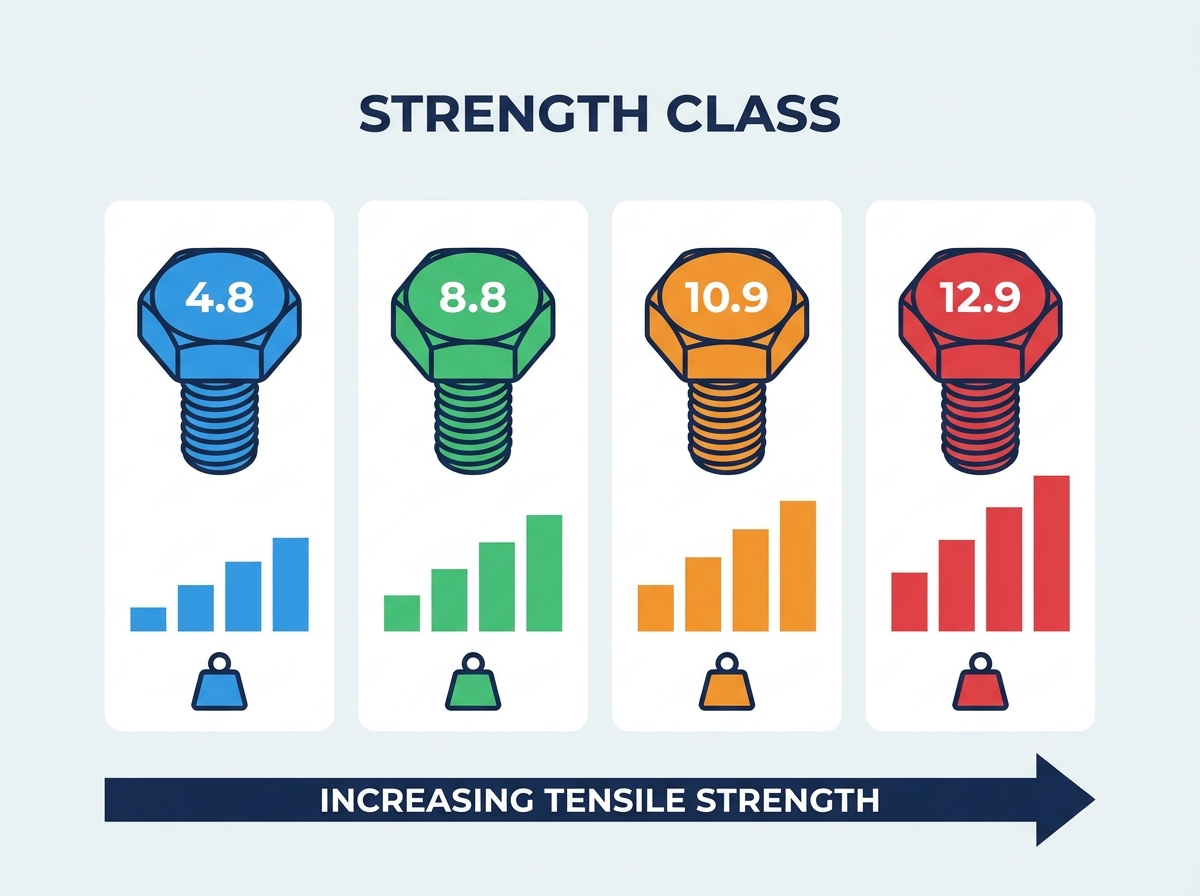
Grade 8.8 serves as the dividing line between standard hardware and engineered structural fasteners. It delivers an ultimate tensile strength of 800 MPa and a robust yield strength of 640 MPa. Manufacturers achieve these properties by using medium carbon steel subjected to rigorous quenching and tempering processes.
This heat treatment alters the internal grain structure of the steel. The factory heats the bolts to extreme temperatures and rapidly cools them in oil or water. They then reheat the bolts to a lower temperature to remove internal stresses. This locks in a high degree of hardness while retaining enough molecular flexibility to resist sudden impacts.
You will find Grade 8.8 bolts functioning as the backbone of modern infrastructure and heavy manufacturing. Their reliable performance profile makes them the default choice for:
Grade 8.8 occupies a practical sweet spot in fastener engineering. It provides substantial clamping force to hold heavy loads securely. Simultaneously, it retains sufficient ductility to absorb shock, vibration, and thermal expansion without snapping. When an 8.8 bolt approaches failure, it stretches visibly. This plastic deformation gives maintenance teams a clear visual warning before total joint separation occurs.
Additionally, Grade 8.8 boasts excellent compatibility with standard corrosion protection methods. You can subject these bolts to standard zinc electroplating and hot-dip galvanizing processes without introducing severe hydrogen embrittlement risks. This makes them highly versatile for outdoor, marine, and chemically exposed environments where rust prevention remains a top priority.
When applications demand clamping forces beyond the capabilities of medium carbon steel, engineers turn to Grade 10.9. This class delivers a massive ultimate tensile strength of 1000 MPa and a yield strength of 900 MPa. Manufacturers produce these fasteners using alloy steel or medium carbon steel enhanced with additives like boron or manganese. The steel undergoes intense quenching and tempering to achieve its final hardness.
The addition of alloys allows the steel to harden deeper and more uniformly during the heat treatment process. This ensures consistent strength throughout the entire cross-section of the bolt, even in larger diameters.
Grade 10.9 fasteners excel in environments where space constraints require smaller bolts to hold immense weight. You specify them for highly engineered, static joints. Common applications include:
The primary trade-off with Grade 10.9 lies in its yield-to-tensile ratio. An 8.8 bolt yields at 80% of its ultimate strength, offering a 20% buffer of plastic deformation before breaking. A 10.9 bolt yields at 90% of its ultimate strength. This leaves only a 10% margin between permanent stretching and catastrophic fracture.
While a 10.9 bolt holds significantly more static weight, it will snap much faster than an 8.8 once external forces exceed its yield point. It offers almost no visual warning of impending failure. You must ensure precise torque application using calibrated tools and strictly control dynamic shock loads when utilizing this grade. A sudden impact on an over-torqued 10.9 bolt often results in an immediate shear failure.
Grade 12.9 represents the pinnacle of standard metric fastener strength. It boasts an ultimate tensile strength of 1200 MPa and an extreme yield strength of 1080 MPa. Achieving these metrics requires high-grade alloy steel subjected to heavy quenching and tempering. The resulting fastener is exceptionally hard and capable of generating immense clamping force.
These bolts often feature a plain, black oxide finish straight from the factory. The manufacturing process tightly controls the metallurgy to ensure maximum tensile performance, leaving very little room for error in application.
You reserve Grade 12.9 strictly for critical, high-tension applications where joint separation would result in catastrophic system failure. They are specialized tools, not general-purpose hardware. Typical use cases include:
The extreme hardness of Grade 12.9 introduces severe implementation risks. The most prominent danger is Hydrogen Embrittlement (HE). During standard electroplating processes like zinc plating, atomic hydrogen can migrate into the steel's grain boundaries. Under high tension, this trapped hydrogen causes the bolt to fracture suddenly and unpredictably, often hours or days after installation.
You must mitigate this risk through strict surface treatment controls. Mandate mechanical galvanizing instead of electroplating. Utilize zinc flake coatings like Geomet or Dacromet, which do not introduce hydrogen during application. If electroplating is absolutely necessary, you must require immediate post-plating baking processes to outgas the trapped hydrogen before the bolts reach the job site.
Furthermore, Grade 12.9 bolts possess very low ductility. They are highly vulnerable to dynamic shock loads. A sudden lateral impact that would merely bend an 8.8 bolt will often shatter a 12.9 bolt instantly. You must design joints using 12.9 bolts to remain strictly static under load.
Understanding the hierarchy of clamping force is essential for proper joint design. The table below illustrates the progression of mechanical properties across the primary metric grades. Use this data to verify your engineering specifications against field realities.
| Property Class | Tensile Strength (MPa) | Yield Strength (MPa) | Material Composition | Primary Risk Factor |
|---|---|---|---|---|
| 4.8 | 400 | 320 | Low/Medium Carbon (Unhardened) | Yielding under moderate loads |
| 8.8 | 800 | 640 | Medium Carbon (Quenched & Tempered) | Under-torquing causing fatigue |
| 10.9 | 1000 | 900 | Alloy Steel (Quenched & Tempered) | Sudden fracture past yield point |
| 12.9 | 1200 | 1080 | High-Grade Alloy (Heavily Tempered) | Hydrogen Embrittlement (HE) |
When designing joints, you must also account for shear strength. As a general engineering rule, the shear strength of a steel bolt roughly correlates to 60% of its ultimate tensile strength. This impacts whether you design a friction grip joint or a bearing joint. A friction grip joint relies entirely on clamping force to prevent plates from slipping. A bearing joint allows the plates to slip until they rest against the bolt shank, which then physically resists lateral shear. Higher grades allow for smaller diameter bolts in friction grip designs, saving space and weight on complex assemblies.
Environmental stress impacts bolt grades differently. Grade 8.8 handles standard weathering well when paired with basic hot-dip galvanization. The thick zinc coating provides decades of sacrificial protection. However, higher grades face complex challenges. Grades 10.9 and 12.9 are highly susceptible to Environmentally Assisted Cracking (EAC) and stress corrosion cracking in marine or chemical environments.
You cannot simply hot-dip galvanize a 12.9 bolt. The heat of the molten zinc bath can alter the bolt's temper, reducing its strength. Additionally, the acid pickling process used to clean the steel before galvanizing introduces hydrogen. You must specify specialized, non-electrolytic coatings to protect high-strength fasteners from environmental degradation without compromising their metallurgical integrity.
Procurement costs scale directly with property classes. Grade 12.9 bolts are inherently more expensive to manufacture due to raw alloy costs and complex heat treatments. However, the true cost lies in implementation. Utilizing high-strength bolts requires precision joint design, specialized hardened washers, matching high-strength nuts, and strictly controlled installation environments.
Specifying a 10.9 bolt for a joint that only requires an 8.8 wastes capital on both the fastener and the required mating hardware. It also increases the labor cost, as installers must use calibrated torque equipment rather than standard impact tools. Always match the grade to the actual load requirement to optimize your project budget.
The global supply chain struggles constantly with counterfeit fasteners. Unscrupulous manufacturers frequently stamp low-carbon bolts with "8.8" or "10.9" markings to sell them at a premium. These counterfeit bolts routinely fail metallurgical testing and cause catastrophic accidents in the field when subjected to design loads.
You must protect your assemblies by enforcing strict procurement standards. Always require Mill Test Reports (MTRs) for high-strength fastener batches. These documents trace the steel's chemical composition and physical testing results back to the original foundry. Source your hardware exclusively from ISO 9001-certified distributors who maintain rigorous quality control and lot traceability protocols.
High-strength bolts only function correctly if properly preloaded. The entire premise of a Grade 8.8 or 10.9 bolt relies on stretching it to a specific percentage of its yield strength to generate clamping force. This clamping force holds the joint together and prevents the bolt from absorbing dynamic loads directly.
Under-torquing a high-strength bolt is highly dangerous. A loose bolt allows the joint to shift. The bolt then absorbs dynamic shear loads directly, leading to rapid fatigue failure and snapping. Conversely, over-torquing pushes the bolt past its yield point during installation, permanently ruining its structural integrity. You must calculate and enforce precise torque specifications based on the bolt grade, diameter, and thread friction coefficient. Always use calibrated torque wrenches for final tightening.
A high-strength bolt is useless without matching hardware. You must pair a Grade 10.9 bolt with a Class 10 nut. If you thread a Class 4 nut onto a 10.9 bolt and apply the required torque, the internal threads of the nut will strip and shear completely long before the bolt reaches its target preload. The nut becomes the weakest link in the assembly.
Similarly, you must use through-hardened steel washers with grades 8.8 and above. Standard soft washers will dish, deform, or embed directly into the joint surface under extreme clamping forces. This embedding causes rapid tension loss, loosening the joint shortly after installation. Always specify the complete fastener assembly as a single engineered system.
Selecting the correct metric bolt grade requires matching mechanical properties to specific load and environmental realities. Higher grades are specialized tools designed for high-tension, static environments where maximum clamping force is mandatory. Understanding these metallurgical limits ensures safe, efficient, and reliable joint design across all your projects.
Take the following steps to secure your structural integrity:
A: Not always. While 10.9 is stronger, it is less ductile. In joints subject to shock or bending, a 10.9 bolt may snap where an 8.8 would safely flex. Furthermore, torque specs must be recalculated to achieve proper preload.
A: The joint will likely fail. A 4.8 bolt has exactly half the yield strength (320 MPa) of an 8.8 bolt (640 MPa). Applying an 8.8 torque spec to a 4.8 bolt will stretch and ruin it immediately.
A: Yes, relative to lower grades. Grade 12.9 bolts have extremely high tensile strength but low ductility, making them vulnerable to sudden brittle fracture under dynamic shock loads or if exposed to hydrogen embrittlement.
A: Metric bolts are required by ISO standards to have their property class (e.g., 8.8, 10.9) stamped directly onto the head of the bolt, along with the manufacturer's identification mark, for sizes 5mm and larger.
A: Roughly, Metric Grade 8.8 is equivalent to SAE Grade 5. Metric Grade 10.9 is equivalent to SAE Grade 8. Metric Grade 12.9 is similar to ASTM A574 socket head cap screws.
A: Yes. The nut property class must match or exceed the bolt grade (e.g., Class 10 nut for a 10.9 bolt). Washers must be hardened to prevent them from dishing or embedding into the joint surface under high clamping forces.